

Skip to content
Wasserstoff

Testing with Hydrogen

Hydrogen is a versatile element that is playing an increasingly important role in various industries and applications. From energy generation to e-mobility, hydrogen has the potential to tackle numerous challenges in the field of sustainable development.

Possible testing methods in hydrogen atmosphere in our laboratory:

  • Fracture mechanics

  • SSRT/ CERT

  • Fatigue tests LCF

  • Fatigue tests HCF/VHCF

Thanks to our innovative, seal-less test cell, tests can be carried out extrem efficiently and accurately:

With up to 1,000 bar

With -60 °C up to +900 °C

With 0% to 100% relative hydrogen humidity

Overview of the test procedures, standards and results:

Testing
Test standards (exemplary)
Test results
1. Fracture mechanics
Threshold
ASTM E647
Kth (K0)
Crack propagation
ASTM E647, DIN EN ISO 11114-4, ISO 12108
Paris Parameter: C,m
Fracture toughness – brittle material
ASTM E399, DIN EN ISO 11114-4, ISO 12135
KIcH
Fracture toughness – ductile material
Material ASTM E1820 (J-integral)
KJIcH
2. SSRT / CERT
ISO 6892-1, ASTM G129
Material properties & area reduction: Rm, Rp 0,2, E (mE), Ag, A, S
3. LCF tests
ASTM E606, ISO 12106
Elastic and plastic material properties
3. 4. HCF / VHCF tests
DIN 50100, ASTM E466, ISO 1099
S-N curve, SlgN

Unique seal-less concept

patented H₂-test chamber

Without the use of moving seals, the pressure chamber offers various advantages:

  1. No friction: no stochastic frictional forces, thus no interference signal and therefore precise force or  strain control.
  2. No wear or leaks (micro-movement at the seal) and therefore no retooling times and lower costs. This makes the tests more efficient and reliable.
  3. No compensation force resulting from pressure and piston area needed.
  4. High test frequencies: This means that fatigue strength tests can also be carried out cost-effectively with statistical validation.
  5. Combination with the SincoTec POWER SWING, which is known for its energy efficiency and high test frequencies. If necessary, slower tests with servohydraulics are also possible.

SINCOTEC hydrogen test laboratory equipment

  • Capacity: Up to 4 test containers with fully
    equipped test equipment
  • Temperature control unit (-60 °C to +220 °C) induction up to 900 °C
  • Hydrogen humidity control system 0% to 100%
  • Infrastructure: Hydraulics, electricity, communication, H2-, N2-supply
  • Test frequencies: Up to 200 Hz
  • Extensive measuring equipment
  • Safety approved
  • Certification: EX approval

Application examples for hydrogen testing:

Fracture mechanics tests for Hydrogen-Pipes up to 200 bar or Hydrogen-Tank materials up to 1,000 bar

  • Pressure: Up to 200 bar; up to 1,000 bar
  • Temperature: Ambient temperature
  • Test frequency: Quasi-static and up to 200 Hz
  • Measurement technology: Force, strain, extensometer, frequency
  • Evaluation: Crack propagation; service life
  • Test standards: E.g: ASTM E647 / ASTM E399; e.g: DIN 50100
  • Actuator: Servohydraulic; resonance
  • Test parts: Pipes; pressure tanks

Fatigue test with temperature for Hydrogen-Internal combustion engines

  • Pressure: 50 bar
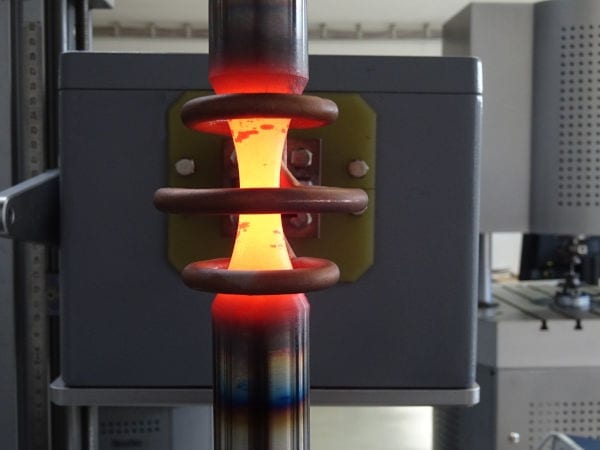
  • Temperature: up to 900 °C (inductive)
  • Test frequency: Quasi-static and up to 200 Hz
  • Measurement technology: Force, strain, temperature (pyrometer)
  • Evaluation: Service life
  • Test standards: e.g: DIN 50100
  • Actuator: Servohydraulic or resonance
  • Test parts: Test parts of Hydrogen combustion engines and compressors

Tensile tests in Hydrogen at low temperatures

  • Pressure: 1,000 bar
  • Temperature: – 60 °C
  • Test frequency: Quasi-static (SSRT)
  • Measurement technology: Force, strain (e.g. ultrasound, extensometer)
  • Evaluation: Material properties (Rm, Rp0.2, E,…) up to 40 % elongation
  • Test standards: E.g: ISO 6892
  • Actuator: Servohydraulic
  • Test parts: Material samples

Tests with 3-point bending or axial load

Hydrogen-Tests under the influence of humidity and temperatures

  • Pressure: Max. 100 bar
  • Temperature: Up to 150 °C
  • Rel. humifity: Approx 5% – 95%
  • Test parts: Materials for fuel cells

Futher test applications in development, including:

  • Tests for the transportation of liquid H₂ at up to – 253 °C

Why SINCOTEC?

SINCOTEC Hydrogen-KNOWHOW

  • Various chambers for testing in a hydrogen atmosphere
  • Testing in horizontal and vertical test systems
  • Safety test chamber for fatigue strength tests with potentially higher risk
  • Patented test cell
  • Testing with resonance and servo-hydraulic test systems
  • Various test methods possible: fracture mechanics (e.g. crack propagation tests), SSRT, fatigue tests, LCF, HCF/VHCF
  • Energy-efficient technology to reduce energy costs
  • Over 35 years of experience in fatigue strength testing for various industries
  • Accredited testing laboratory with more than 160 different testing machines
  • Manufacturer of testing systems
  • Member of the North German Hydrogen Strategy
Contact

Hydrogen embrittlement under control?

Using our specialized test rigs, we evaluate your materials and components under realistic H₂ conditions – delivering reliable data on service life, safety and material behavior. Get in touch – together we’ll develop the right testing strategy for your application.

Similar topics

Service load testing

Service load testing

From the road to the lab. Replicating real measured or gathered load signals on your component.
Environmental simulation

Environmental simulation

Replicate your component's operational conditions by complementing mechanical testing with environmental simulations.

Test Systems

Outside of our standard test systems, control units, and testing and evaluation software, we also develop custom test systems to…