Rails & welded joints tested for infinite fatigue life – for greater safety in rail transport
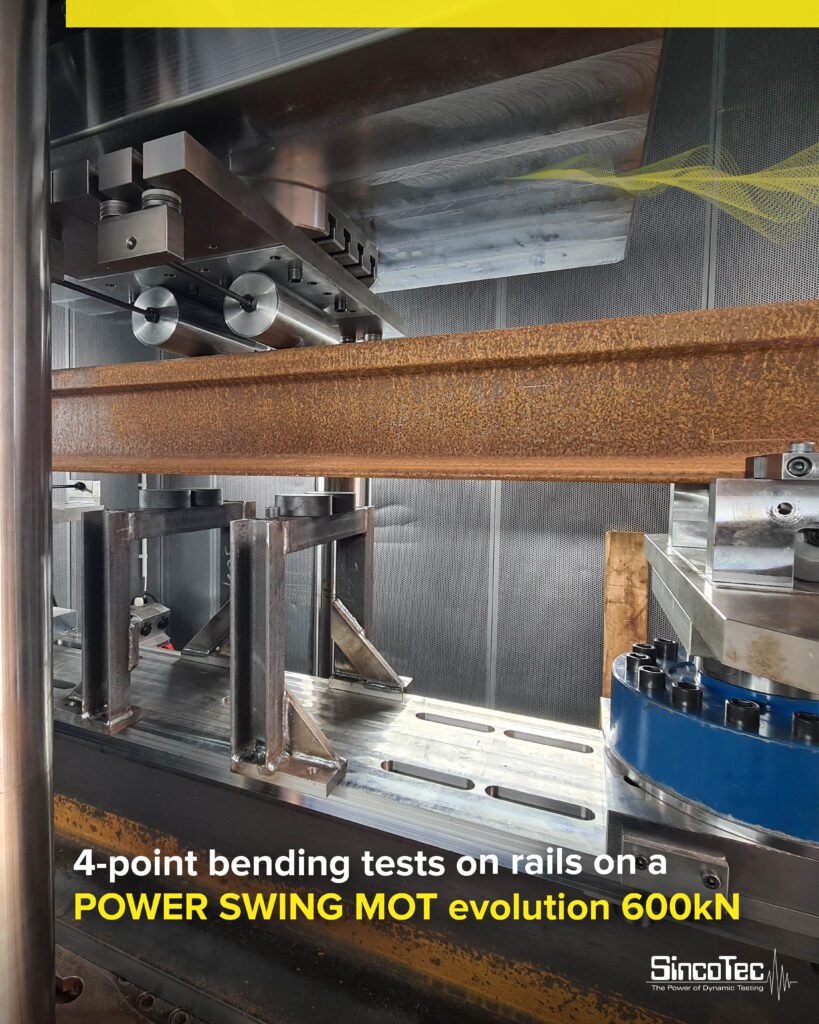
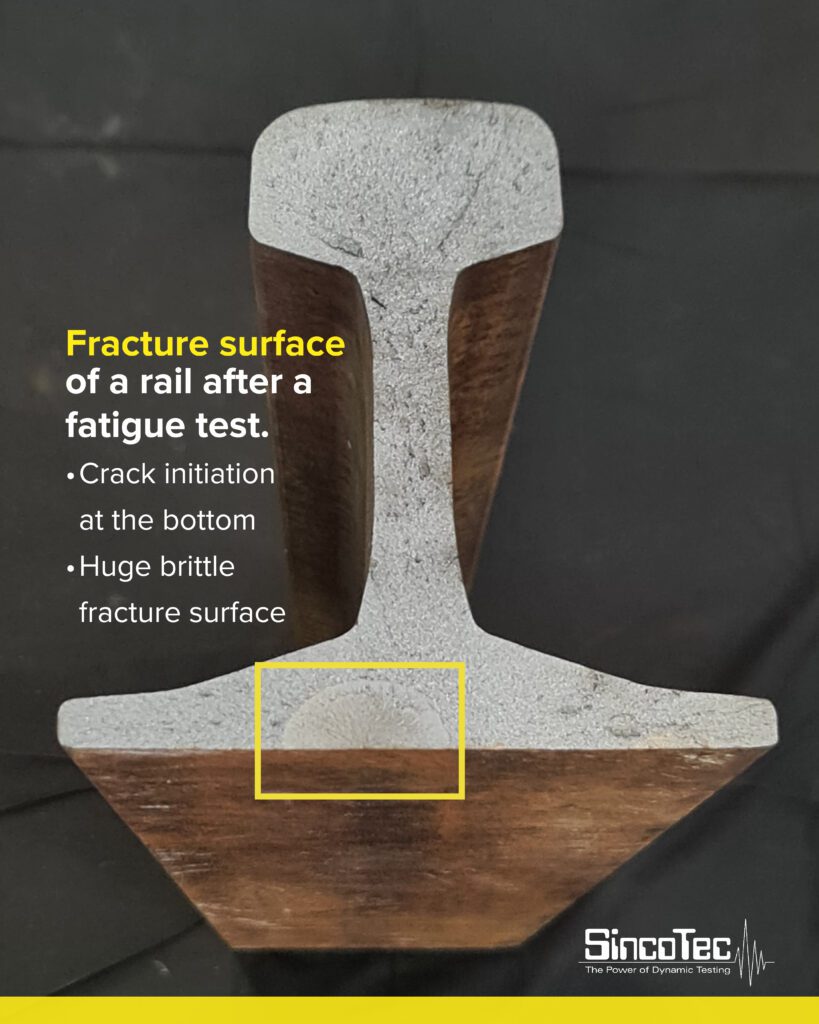
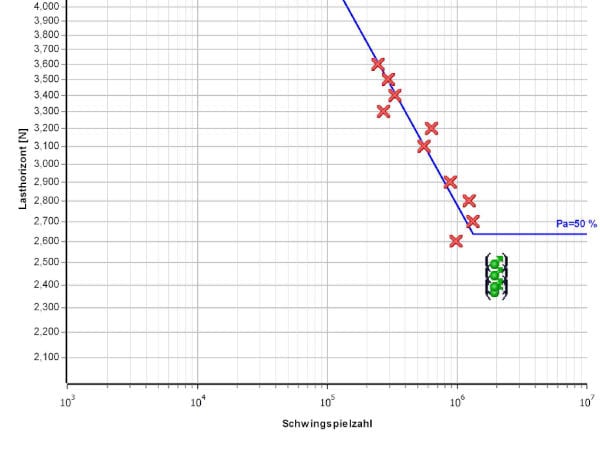
We are currently performing fatigue tests on rails in our fatigue testing laboratory. In doing so, we investigate whether the rail can withstand the many cyclic loads under environmental influences up to the fatigue limit. Rails must be designed for infinite fatigue life.
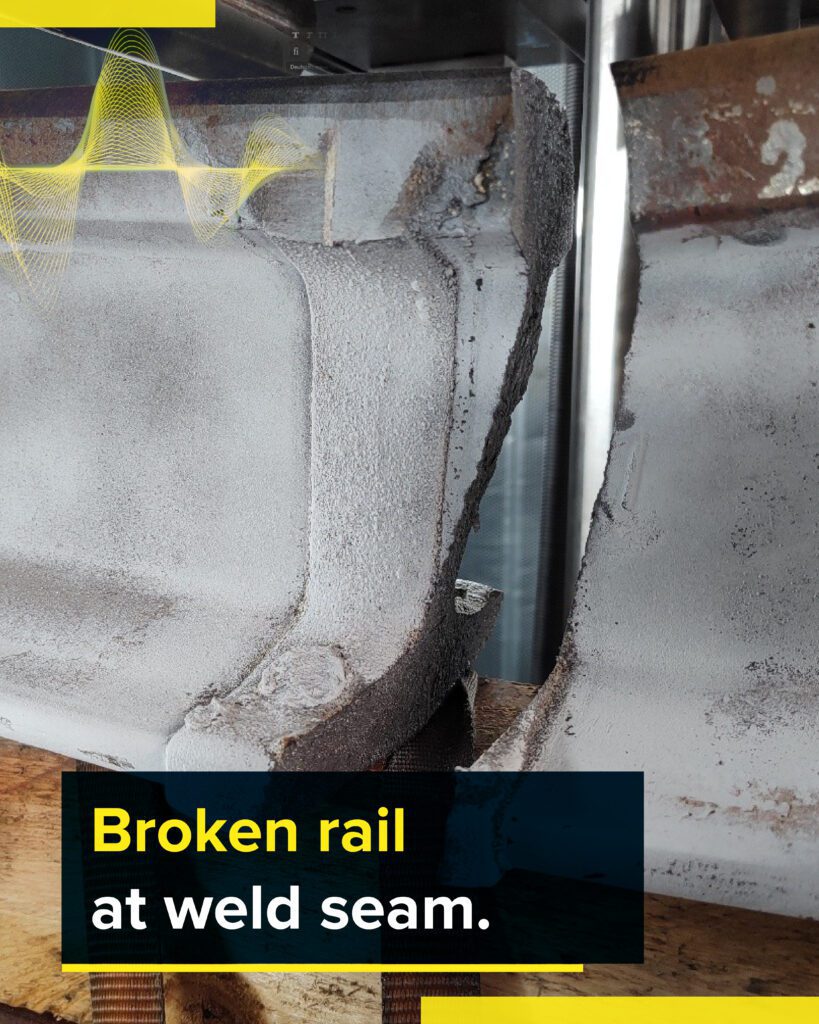
When a train runs over a rail, the rail deflects under the axle load and is therefore subjected to bending stress. The higher the train weight, the greater the load. In our tests, we can apply 40 bending load cycles per second, which corresponds to the bending loading during the passage of a high-speed train (approx. 8 cars). To verify the fatigue limit, we apply 5 million load cycles in a short time — quickly and efficiently. This means the 2-day test corresponds to the passage of 125,000 trains. The most critical areas of a rail are the welded joints, as the strength is lower there.
After our first rail testing applications using the POWER SWING resonance testing machine, we have now carried out extensive test series for various customers:
👉 Over 30 rail specimens — welded and non-welded segments — were investigated for fatigue behaviour and fatigue life up to fracture. Both newly rolled rails and in-service rails were tested.
All tests were performed as vertical four-point bending fatigue tests using a clamping fixture specifically designed for this application, with adjustable support points and adjustable load introduction points.
The POWER SWING is based on the resonance principle, and compared with a conventional servo-hydraulic test rig, our setup is significantly more energy-efficient and faster.
To also represent the effects of corrosion, selected specimens were pre-corroded in a test chamber and/or artificially aged prior to fatigue testing. For this purpose, we use our proven SALT LAKE conditioning unit, which provides a reproducible test solution for standard-oriented corrosion testing.
Would you like to learn more?
We have dedicated an article to this topic in our SincoTec news 12/2025: Safely to the destination – POWER SWING ahead: Railway rails on the test system! SincoTec defines new standards in rail testing
Do you have any questions or would you like to discuss the topic further?
Feel free to call us directly or send us an email.
We provide personalized, individual advice—from individual tests to system solutions. Our fatigue strength experts will support you with your testing tasks. Let’s work together to make the world a safer place!
Newly Developed Controller Hardware for Forced Excitation Test Systems
TestPilot 2.0
Our in-house developed TestPilot hardware has undergone a significant upgrade. The enhancements include an increased measurement and control rate of 50 kHz per channel and improved measurement accuracy to 24 bits. Utilizing a high-performance, real-time capable MultiCore CPU, TestPilot 2.0 is equipped to handle increasingly complex testing tasks.
The controller is versatile, available either as a standalone unit or for cabinet installation in two different sizes. The first variant is a cost-effective, up to two-axis version suitable for simpler test setups. The second is an up to eight-axis version designed for more demanding multi-axis applications. Both versions have enhanced digital inputs and outputs, now featuring 32 of each, with some capable of functioning as counter inputs (A or AB).
Safety has also been elevated in the new model. By incorporating special positively driven relays with feedback to control media release, the system achieves Performance Level “d” (ISO 13849), ensuring higher safety standards.
TestPilot 2.0 continues to be operated via our well-established CoPilot PC software, which supports seamless integration and operation with all generations of TestPilot controllers.
Key Features of TestPilot 2.0:
Measuring and control rate of 50 kHz per channel
Measurement accuracy of 24 bits
Available as a standalone device or for cabinet installation in two configurations:
Up to two-axis for simpler setups
Up to eight-axis for complex multi-axis applications
32 enhanced digital inputs and outputs, some usable as counter inputs
Enhanced safety with Performance Level “d” certification
Operated using the trusted CoPilot software for effortless compatibility with previous controller generations
TestPilot 2.0
SincoTec CoPilot user interface with running test
How can we help you?
When it comes to testing your products, components or assemblies for their load capacity, service life and reliability, we have the right solution. Please briefly describe your problem, we will be happy to get back to you in a timely manner!
New development: flow-through internal pressure pulsation test rig
Internal pressure pulsation test rig
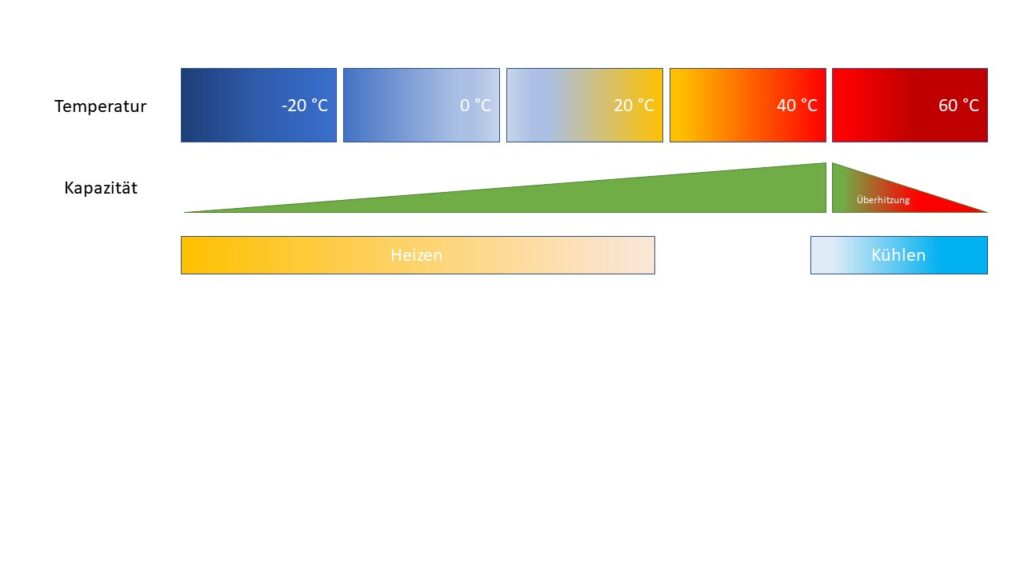
One not immediately visible but nevertheless relevant stress for vehicles with electric drives is the temperature of the individual components of the powertrain. Winter temperatures of -20°C can reduce the range of an e-vehicle by approx. 50%. Consistent monitoring and adjustment of the temperatures of the individual components in the e-drive can significantly improve performance, range and service life. An example of this is the battery. This is cooled in summer and during charging, but must be heated in winter. Thanks to the high efficiency of electric drives, they themselves produce relatively little waste heat. Additional components such as electric auxiliary heaters and heat pumps must therefore be used for heating. In addition, there is a large number of electrically controlled valves, evaporators, fans etc. It is therefore no longer appropriate to speak of a “pure cooling system” for an e-drive vehicle, but rather of a “thermal management system”.
Within this system, there are a large number of components that are subjected to two different temperatures at the same time. On the one hand with the temperature of the coolant, on the other hand with the ambient temperature in which the component is located. Added to this are pressure fluctuations in the cooling system. In order to be able to better simulate this load situation for testing the components, SincoTec Test & Engineering developed a flow-through internal pressure pulsation test rig. On this test rig, the above-mentioned components, but also other components, can be flowed through with a temperature-controlled coolant and simultaneously subjected to pressure pulsation while these components are at an ambient temperature that differs from the coolant temperature. Ambient temperatures between -40°C and 140°C, media temperatures up to 120°C, pressures between 0 bar and 5 bar (relative) and volume flows up to 50 l/min can be generated.
Internal pressure pulsation test rig
Diagram: Performance of a battery related to temperature
How can we help you?
When it comes to testing your products, components or assemblies for their load capacity, service life and reliability, we have the right solution. Please briefly describe your problem, we will be happy to get back to you in a timely manner!